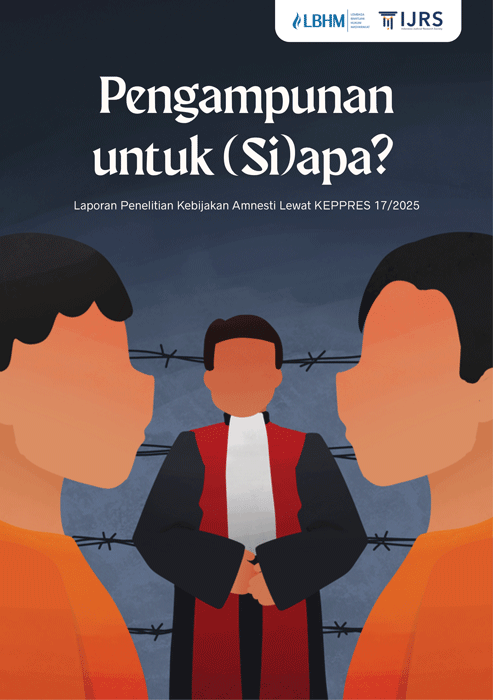
Amnesty for Whom? A Policy Research Report on the Amnesty Policy under Presidential Decree No. 17/2025
Author:
Writing Team:
Adi Nugroho
Albert Wirya
Kiki Marini Situmorang
Enumerators:
Muhammad Tori
Syana Mifta Salsabila
Syifadilla Subagyo Putri
Siti Ismaya
Aditya Weriansyah
Published Year:
2026
Book Specifications :
B5 (17.6 x 25 cm)
Synopsis:
Amnesty has long been part of Indonesia’s state governance practices, ranging from efforts to ease political conflict to correcting criminalization. However, recent practices show that this policy has not been fully well-targeted and still leaves various issues in terms of justice, accountability, and its effectiveness within the correctional system. Going forward, amnesty must be seriously reformed through the establishment of clear, transparent, and accountable regulations, with measurable criteria for recipients based on risk and vulnerability. This policy must also prioritize non-violent groups and vulnerable populations, avoid disparities among offenders in similar cases, and ensure that delays leading to human rights violations no longer occur. At the same time, amnesty cannot continue to serve as the primary solution to prison overcrowding without being accompanied by comprehensive reforms in sentencing policies, including reducing reliance on imprisonment and improving narcotics policies.