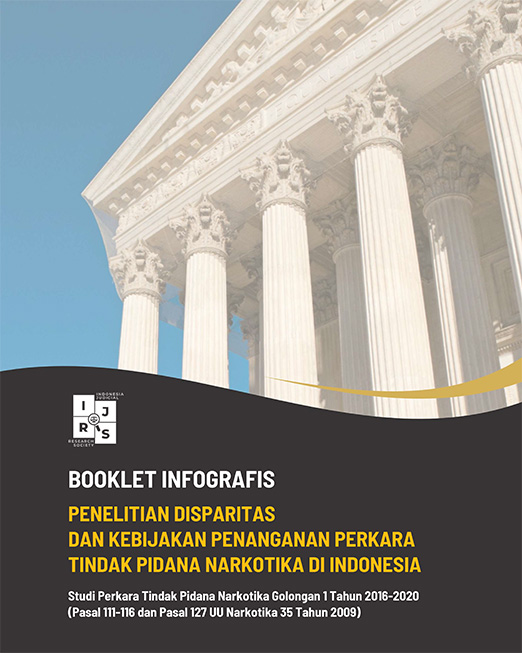
Infographic Booklet of Research On Sentencing Disparity and Criminal Policy of Narcotics Offence Cases In Indonesia
Author:
Matheus Nathanael,
Andreas Nathaniel Marbun,
Nanda Oktaviani,
Adery Ardhan Saputro,
Gladys Nadya Arianto,
Muhammad Ad’har Nasir,
Maria I. Tarigan,
Anugerah Rizki Akbari,
Maidina Rahmawati,
Erasmus A.T. Napitupulu
Published Year:
Book Specifications :
14,8 x 21 cm
Synopsis:
This booklet is the result of comprehensive and in-depth research conducted by the Indonesia Judicial Research Society (IJRS), an institution that is concerned with the field of judicial research and advocacy in Indonesia regarding various law enforcement problems in narcotics cases that are experienced every day. Currently, perpetrators of criminal acts of narcotics abuse are no longer considered criminals who must be imprisoned, but rather are seen as victims of narcotics abuse. This paradigm change certainly has an impact on treatment patterns. As a consequence of this view, narcotics abusers will have a more appropriate treatment pattern if they receive rehabilitation and not be sentenced to prison. This is in line with the spirit of implementing restorative justice for narcotics, namely the spirit to restore the situation to normal for victims of criminal acts by taking into account the principle of ultimum remedium as well as the principles of fast, simple and low-cost justice.
(This publication only available in Bahasa Indonesia)
You can also access the complete research results here: