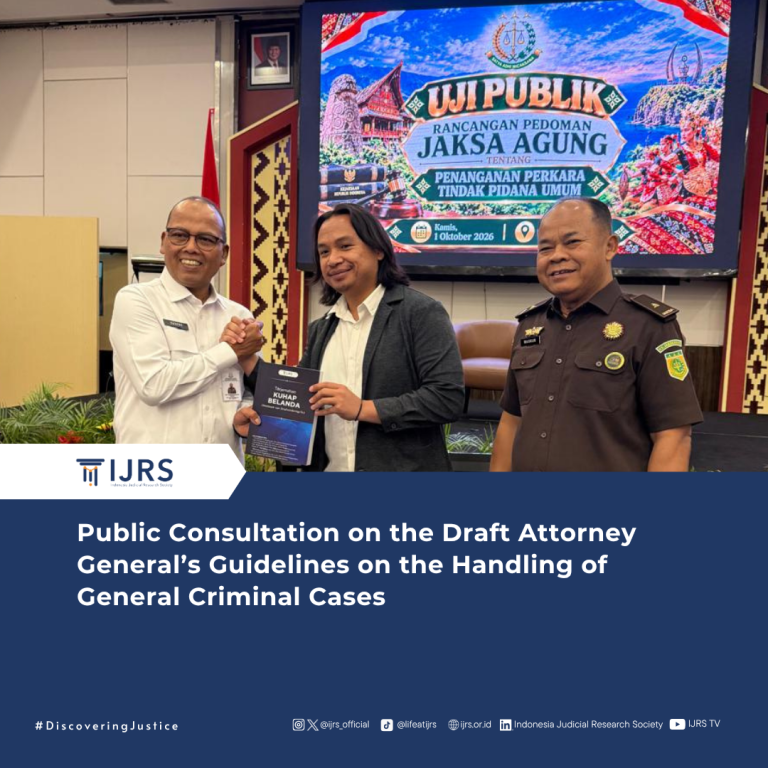


Jakarta, October 5, 2026 – The Indonesian Judicial Research Society (IJRS) was invited to participate in a focus group discussion (FGD) on the theme “Strategies for Controlling Prosecution and Implementation of Court Ordered Measures Against Corporations in Natural Resource Crimes Under Article 123 of the Indonesian Criminal Code Based on Active Functional Dominus Litis Through Technical Instructions in Support of Just and Sustainable National Economic Development.” IJRS was represented by Matheus Nathanael (Program Manager for the Criminal Justice Reform Division) and Alexander Tanri (Researcher). The event was also attended by Fachrizal Afandi (Academic at Brawijaya University), Y.M. Raden Heru Wibowo Sukaten (High Court Justice), Rilke Jeffri Huwae (Directorate General of Law Enforcement, Ministry of Energy and Mineral Resources), Rudianto Saragih Napitu (Director of Law Enforcement, Ministry of Forestry), and representatives from the National Police Education and Training Institute.
About the Guidelines
The Attorney General’s Office is drafting Guidelines to guide the application of Article 123 of the Criminal Code concerning Imposition of Measures on Corporations. These Guidelines aim to provide standards for Public Prosecutors in filing charges and enforcing decisions on measures against corporations in natural resource cases.
Response from IJRS:
The absence of technical regulations derived from the New Criminal Code and Criminal Procedure Code (Government Regulations) has created uncertainty in law enforcement practices, necessitating “temporary” regulations to guide law enforcement. It is undeniable that even though the legal framework implementing the New Criminal Code and Criminal Procedure Code is incomplete, the diversity of cases in the field presents a significant challenge for law enforcement in implementing the New Criminal Code and Criminal Procedure Code, even though there are no technical regulations. There are three important points: First, the absence of technical regulations cannot be used as an excuse by law enforcement (especially the courts) to reject a case or be reluctant to implement new provisions in the new law that have already been enacted. Second, without technical regulations, the practice of law enforcement in the field will be diverse, and in the long term, will result in widespread legal uncertainty. Third, the government’s delay in enacting technical regulations for the new law needs to be anticipated by issuing “temporary regulations” issued by relevant institutions, even if these are limited to internal regulation without affecting cross-institutional authority and are only temporary in nature.
Guidelines need to establish indicators for selecting the appropriate type of action for each case. These guidelines already stipulate indicators for when a corporation should be prosecuted along with criminal sanctions, or when sanctions alone are sufficient. However, these guidelines do not yet stipulate indicators for selecting the appropriate type of sanctions for each case.
These guidelines need to regulate the types of corporations that can be subject to criminal sanctions and/or measures. Not all types of corporations are suitable for criminal sanctions/measures. The guidelines already recognize this by limiting corporate takeovers to certain legal entities. This limitation needs to be expanded to include guardianship and supervision, as these three measures cannot be applied to unincorporated corporations. Furthermore, questions remain regarding the effectiveness of imposing sanctions on state-owned enterprises (BUMN) and region-owned enterprises (BUMD), as these corporations are owned with the aim of providing state/regional revenue, imposing sanctions could hinder the objectives in operating these SOEs. To address this issue, the doctrine of corporate criminal liability must be applied appropriately to determine when corporations should be prosecuted and when prosecuting their directors is sufficient.
Comparison of the Application of Sanctions to Corporations: Continental European Tradition (Netherlands & Italy) vs. Anglo-Saxon Tradition (United States & Canada). From the comparison of the countries above, four points can be obtained. First, corporate takeovers are not recognized as sanctions for corporations committing criminal acts, but are better known in the areas of civil or commercial law. The concept of corporate takeovers as sanctions by the state for crimes committed by corporations is confusing, because this action actually punishes corporate shareholders who are yet to be proven guilty, even though the corporation itself is the subject being accused and prosecuted. Second, countries with continental European traditions such as the Netherlands and Italy only recognize corporate guardianship measures. Meanwhile, countries with Anglo-Saxon traditions only recognize corporate supervision actions as a type of crime. The Indonesian criminal justice system actually recognizes both, but without detailed regulations in the law on what differentiates them and the technical implementation. Third, the Dutch and Italian systems recognize corporate guardianship actions that are carried out when a corporation commits a crime that is still considered minor (not serious), and the corporation is seen as having a significant contribution to the economy, so that the corporation needs to be placed under guardianship for change and improvement (active law enforcement, semi-passive corporation). Fourth, the United States and Canada recognize criminal supervision for corporations committed by corporations committing crimes and corporate circumstances similar to the description of corporate guardianship actions in countries with continental European traditions above. However, the procedures for criminal supervision for corporations are slightly different, and more similar to criminal supervision for individuals (active corporations, semi-passive law enforcement). In Canada, corporations are given conditions that must be met over a certain period of time to demonstrate that the corporation has made the necessary changes to improve corporate traffic that minimizes and prevents the recurrence of criminal acts. If there is a violation of the conditions during the supervision period, the corporation can be subject to more severe types of criminal sanctions, such as fines.