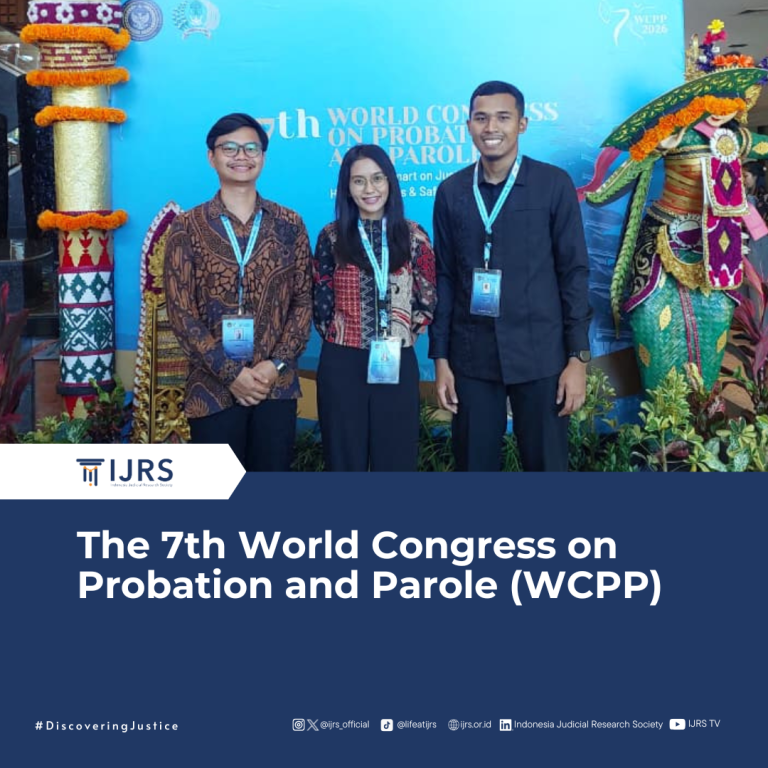
From 14 to 17 April 2026, the Indonesia Judicial Research Society (IJRS) had the opportunity to participate in The 7th World Congress on Probation and Parole (WCPP) 2026. In this international forum, one of IJRS’s researchers, Saffah Salisa Azzahro, also served as moderator in two parallel discussion sessions. Under the theme “Getting Smart on Justice: Healing Hearts & Safer Societies,” this year’s congress highlighted the importance of effective strategies within the criminal justice system to achieve crime prevention, restore relationships between offenders, victims, and society, and foster safer communities. One of the sessions moderated by Salisa took place on 15 April 2026 during Parallel Session 3 in the Frangipani Room, featuring two speakers: Michał Sopiński and Yasuki Yamaguchi. Michał Sopiński currently serves as the Rector-Commandant of Akademia Wymiaru Sprawiedliwości (the University of Justice), Poland, and has professional experience within the Polish Ministry of Justice, the Supreme Court of Poland, and legal academia. Meanwhile, Yasuki Yamaguchi is a professor at the United Nations Asia and Far East Institute for the Prevention of Crime and the Treatment of Offenders (UNAFEI), and previously worked as a probation officer and as an official in the Rehabilitation Bureau of the Ministry of Justice, Japan. The discussion brought together two important perspectives. In his presentation, Michał Sopiński discussed efforts to professionalize probation in Poland through a standardized national training model. He explained how educational reform for probation officers can strengthen the quality, consistency, and public trust in probation services, particularly through standardized training, collaboration between academics and practitioners, and the integration of theoretical learning with field practice. This demonstrates that strengthening the capacity of probation officers is an essential component of the justice system, both for improving offender reintegration and for enhancing public trust. Meanwhile, Yasuki Yamaguchi offered a more critical perspective by examining the relationship between racism, capitalism, and the criminal justice system in Japan. Through his analysis of the experiences of minority groups and migrant workers, he explained that criminal justice systems are not always sufficiently responsive to marginalized communities so far. His presentation served as a reminder that efforts to support offender reintegration must also take into account the experiences of marginalized groups, including through offender assessment under the RNR Model and through the training of probation officers.
On 16 April 2026, Salisa also served as moderator for Parallel Session 4 in the Frangiapani Room. This session brought together two important conversations on the future of probation and parole. The first featured Helen Glazebrook and Tracey O’Brien. Helen is a leading criminal intelligence expert with extensive experience in intelligence reform across Australian corrective services, including custodial, parole, probation, and youth justice sectors. Tracey O’Brien is a Prosci Certified Change Management Practitioner. The second presentation featured Julie Truschel and Dr. Ioan Durnescu. Julie is the CEO and Founder of the Supervision Around the World (SAW) Project, with decades of practical experience across juvenile and adult justice systems, while Dr. Ioan Durnescu is a Professor at the University of Bucharest, co-author of The Avalanche of Technology: Critical Perspectives on Digital Penalty, and a leading scholar on probation and digital innovation. The discussion highlighted two complementary perspectives on strengthening probation systems. Helen Glazebrook and Tracey O’Brien emphasized how cross-disciplinary collaboration between intelligence, change management, and operational functions can strengthen rehabilitation, improve staff and client safety, and support safer reintegration from custody to the community. Their presentation showed that intelligence-led approaches should not be confined to custodial settings, but can also be integrated across probation and parole through clear governance, trusted communication, and sustainable organisational reform. Meanwhile, Julie Truschel and Dr. Ioan Durnescu explored the expanding role of technology in criminal justice, from electronic monitoring and digital assessments to artificial intelligence, algorithmic risk prediction, and virtual-reality rehabilitation. Their session underscored that technology can improve supervision outcomes and decision-making when used with professional judgment, compassion, and ethical safeguards. At the same time, they cautioned against the risks of excessive surveillance, privacy concerns, and the erosion of human connection, reminding participants that justice innovation must remain grounded in dignity, fairness, and human agency. This session offered another valuable learning space for IJRS, particularly as Indonesia continues to strengthen its probation system under the new Criminal Code. The exchange reaffirmed that the future of probation depends not only on sound legal frameworks, but also on professional capacity and institutional readiness to respond to increasingly complex community-based supervision challenges.